Current Issue
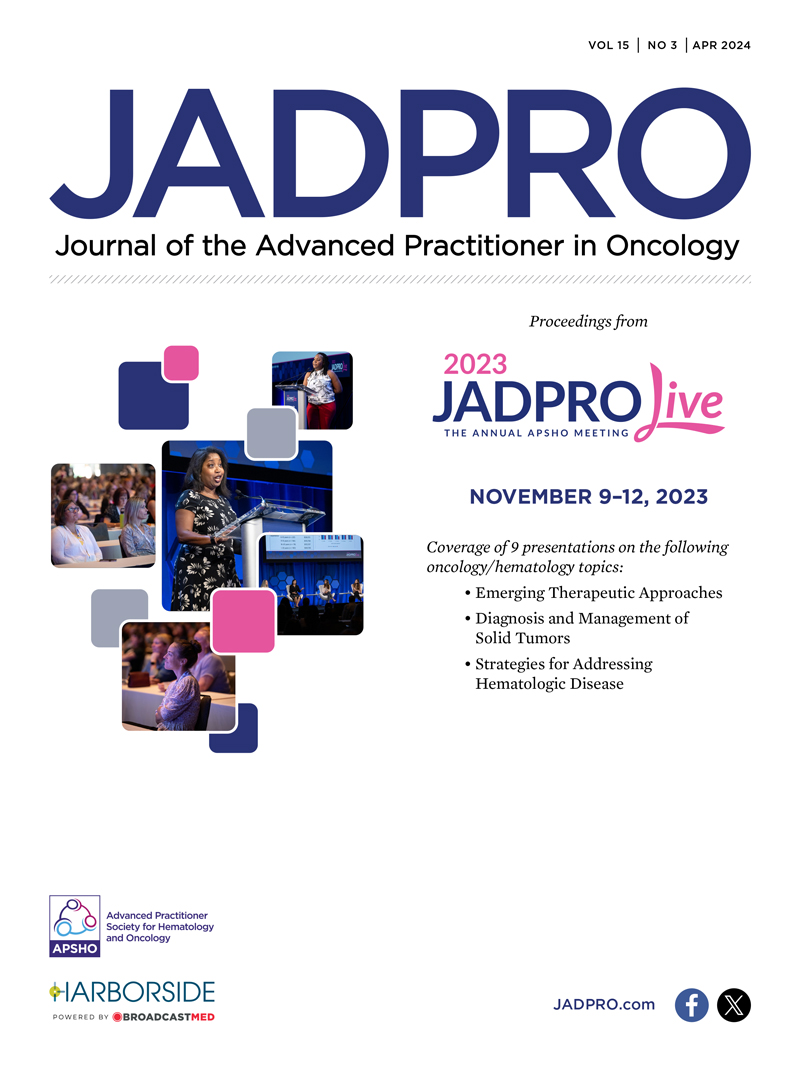
VOL 15 NO 3 • Apr 2024
This issue’s cover illustration depicts highlights from JADPRO Live 2023.EditorialBeth Faiman, PhD, MSN, APRN-BC, AOCN®, BMTCN, FAAN, FAPOLast fall, the 2023 JADPRO Live conference welcomed more than 1,500 in-person attendees and 200 virtual attendees. Sessions took place at the Orlando World Center Marriott from November 9 through 12. Select CE-accredited sessions were livestreamed, and all CE-accredited sessions were available on...
Meeting ReportPresented by Andrew Guinigundo,(1) MSN, RN, CNP, ANP-BC, FAPO, and Grace Baek,(2) PharmD, BCOPThe identification of biomarkers based on oncogenic driver mutations has led to significant advancements in managing patients with cancer. At JADPRO Live 2023, Andrew Guinigundo, MSN, RN, CNP, ANP-BC, FAPO, Director of Precision Oncology at Cincinnati Cancer Advisors, and Grace Baek, PharmD, BCOP...
Meeting ReportPresented by Lisa M. Holle, PharmD, BCOP, FHOPA, FISOPPAt the popular New Drug Updates session at JADPRO Live 2023, Lisa M. Holle, PharmD, BCOP, FHOPA, FISOPP, clinical professor at UConn School of Pharmacy and UConn School of Medicine, and oncology pharmacist at UConn Health Neag Comprehensive Cancer Center, reviewed new US Food and Drug Administrat...
Meeting ReportPresented by Rebecca L. Rezac, PharmD, BCOPAt the Drug Updates session at JADPRO Live, Rebecca L. Rezac, PharmD, BCOP, a board-certified oncology pharmacist at the University of Colorado Hospital in the UCHealth Blood Disorders and Cell Therapies Center, reviewed recent US Food and Drug Administration (FDA) approvals in hematologic malign...
Meeting ReportPresented by Sandra Cuellar, PharmD, BCOP, FHOPA, FASHPIn the past 10 years, the FDA has approved over 330 drugs in the oncology space. The majority of approvals (around 60%) have been label expansions, followed by next-in-class therapies (25%), and new mechanisms of action (16%).
At JADPRO Live 2023, Sandra Cuellar, PharmD, BCOP, FHOPA, FASHP, a cli...
Meeting ReportPresented by Stephanie L. Graff,(1,2) MD, FACP, FASCO, Christine McGinn,(1) MSN, APRN, ACNP-BC, and Jeanine R. Showalter,(3) MSN, APRN, FNP-BC, AOCNP®The landscape of metastatic human epidermal growth factor receptor 2 (HER2)-positive breast cancer is changing rapidly. At JADPRO Live 2023, Stephanie L. Graff, MD, FACP, FASCO, of Legorreta Cancer Center at Brown University and the Lifespan Cancer Institute, Christine McGinn, MSN, APRN, ACNP-BC,...
Meeting ReportPresented by Tajuana Bradley,(1) MSN, APRN-BC, and Beth Sandy,(2) MSN, CRNP, FAPOAdvances in the past two decades in targeted therapy and immunotherapy have significantly improved the treatment of patients with metastatic non–small cell lung cancer (NSCLC). At JADPRO Live 2023, Tajuana Bradley, MSN, APRN-BC, a nurse practitioner at Georgia Cancer Specialists affiliated with t...
Meeting ReportPresented by Mary B. Morgan,(1) MSN, ANP-BC, AOCN®, and Tammy Triglianos,(2) DNP, ANP-BC, AOCNP®Colorectal cancer is the third most common cancer diagnosis in men and women, and the second leading cause of cancer-related deaths. At JADPRO Live, Mary B. Morgan, MSN, ANP-BC, AOCN®, of Simmons Comprehensive Cancer Center, and Tammy Triglianos, DNP, ANP-BC, AOCNP®, of UNC Lineberger Comprehensi...
Meeting ReportPresented by Jessica Deinert, MSN, APRN, FNP-C, AOCNP®, and Leah K. Shaw, MSN, APRN, AGPCNP-BC Recent research has advanced our understanding of the treatment of prostate cancer. At JADPRO Live 2023, Jessica Deinert, MSN, APRN, FNP-C, AOCNP®, and Leah K. Shaw, MSN, APRN, AGPCNP-BC, both from the department of GU medical oncology at The University of Texas MD Anderson Cancer Center, provide...
Meeting ReportPresented by Beth Finley-Oliver, MSN, ARNP, AGNP-BC, and Rachid Baz, MDThere have been enormous improvements in the treatment of patients with multiple myeloma (MM), leading to patients living longer with the disease. At JADPRO Live 2023, Beth Finley-Oliver, MSN, ARNP, AGNP-BC, a nurse practitioner in the department of Malignant Hematology at Moffitt Cancer Center, ...


